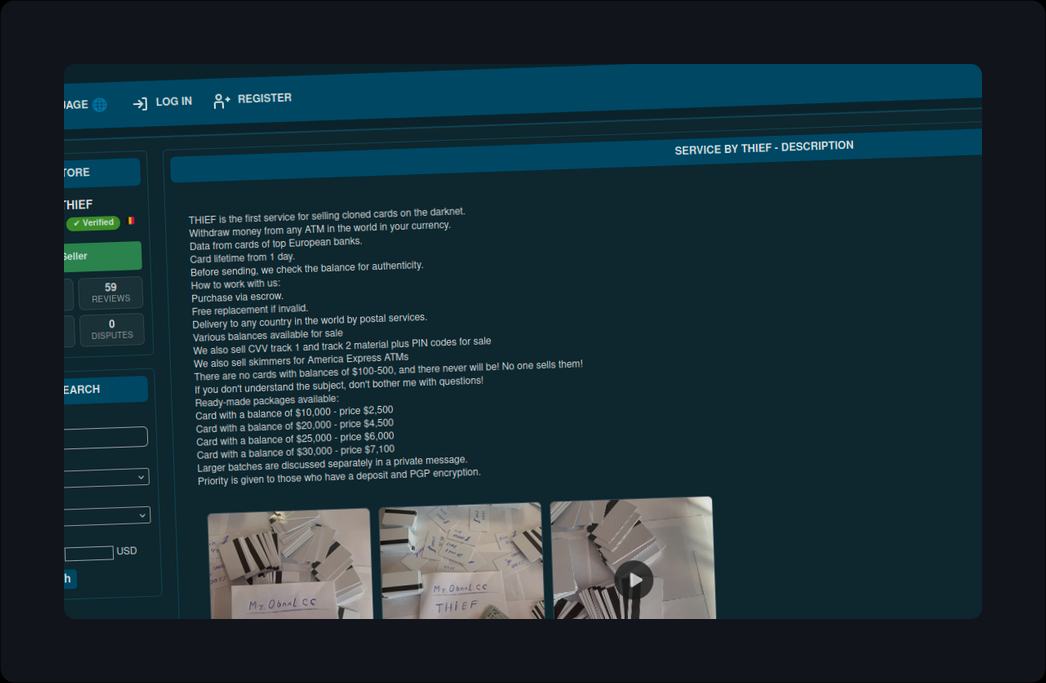
Mark T., a 34-year-old resident of Tampa Bay, Florida, thought he had found easy money. In November 2024, he purchased a set of six cloned debit cards with PIN codes on a darknet marketplace for $480 in cryptocurrency. The cards were encoded with stolen magnetic tracks from real accounts — a classic product of the carding market. The first three ATMs gave him a total of $4,200 in cash. The fourth ATM became his last.
This is not a story about how to buy a card. This is a story about how an elusive criminal stopped being elusive in 72 hours, why ATM cameras are more effective than any detective, and how a chain of digital evidence — stretching from a crypto wallet to the U.S. Secret Service — led to 5 years in federal prison.
1. How carding works: the chain
Carding is the sale and use of stolen banking data — one of the oldest and most resilient forms of cybercrime.
The scheme Mark used followed a classic sequence:
Skimming or data breach: criminals collect magnetic card tracks (track 1/track 2) through skimmers on ATMs, shimmer devices, phishing, or by purchasing dumps on darknet markets.
Embossing: the stolen data is written onto blank plastic. The card is given the appearance of a real one — embossed name, expiration date, card number.
PIN code: if the PIN was compromised through an overlay keypad or hidden camera on an ATM, the buyer receives a ready-made instrument for cash withdrawal.
Cash-out: the buyer withdraws money from an ATM before the victim notices and blocks the card.
Laundering: the cash is converted into cryptocurrency through a Bitcoin ATM or P2P exchange, washing the trail.
Mark bought the cards on a marketplace that this article does not name. Payment was in Monero — chosen specifically for its tracking difficulty. The cards arrived by mail in neutral packaging. Everything looked like a successful transaction.
But in this scheme there is one detail that buyers often underestimate: an ATM is not just a cash dispensing device. It is an evidence collection device.
2. The vulnerability Mark didn't account for: the camera
A modern ATM is not just a bill dispenser — it is a comprehensive surveillance system.
Inside almost every ATM, the following is installed:
Built-in camera: aimed at the client's face, records at 1080p resolution, often with infrared illumination for night mode.
Hidden camera: in many models, a second camera is installed at a different angle, not visible from the outside.
Transaction log: every withdrawal is recorded with accuracy to the second — time, amount, card number, ATM number, transaction status.
Geolocation: the ATM knows its coordinates and transmits them to the bank's log.
Network log: requests to the bank's processor are logged, including connection metadata.
When Mark approached the fourth ATM in a Tampa Bay suburb, the built-in camera recorded his face in full profile — no mask, no glasses, no hat. He withdrew $700, took the card, and left. Twenty-three seconds of video footage. That was enough.
Offenders think the anonymity of the darknet protects them in the physical world. But an ATM is not a darknet node. It is a point where digital crime becomes physical, and here anonymity ends.
3. How the investigation proceeded: timeline
The case moved from first complaint to arrest in fifteen days.
Day 1 — November 2024: three victims in three states (Florida, Georgia, North Carolina) notice unauthorised withdrawals from their accounts and file complaints with their banks. The banks block the cards and pass the data to the early fraud warning system.
Day 3: the bank's anti-fraud system algorithms identify a pattern — withdrawals from the same group of cloned cards in different states over a short period. An emergency flag is raised automatically. The case is transferred to the bank's investigation department.
Day 5: the bank passes the case to the U.S. Secret Service (USSS), which has jurisdiction over financial crimes. A USSS analyst requests logs from all involved ATMs and video recordings.
Day 8: video from the fourth ATM provides a clear image of a face. Comparison with the Florida Department of Public Safety (DPS) driver's licence database returns a match: Mark T., no prior convictions. In parallel, transaction analysis shows that all withdrawals were made within a 40-mile radius of his home address.
Day 12: the investigator obtains a warrant for electronic traces — browser history, ISP records, crypto wallet activity. ISP analysis shows visits to Tor exit nodes during hours corresponding to the purchase. The Monero wallet is linked to an account on the darknet marketplace through a court order to the exchange where Mark purchased Monero.
Day 14: the court issues a search warrant for the house. During the search of the apartment, the following are seized: six blank plastic cards, a magnetic stripe read/write device (MSR), a laptop with a history of visiting darknet marketplaces and traces of Tor Browser, $3,200 in cash, and packaging from the shipment.
Day 15: Mark is arrested. During interrogation, he confesses to buying the cards and cashing out four of the six. The remaining two did not work — the cards had already been blocked by the bank by the time he attempted to use them.
4. The numbers
Here is how the money moved and what the consequences were.
Post-release supervision: 3 years
Time from first cash-out to arrest: 15 days
Fine plus restitution: 22,000 USD
Cash-outs: 4
Total taken out: 4,900 USD
Federal prison term: 5 years (60 months)
Price of the cloned cards: 480 USD
Before attempting any physical cash-out, a buyer should ask how to tell if a card reader has a skimmer — but the ATM itself records far more than most people realise. The table above reflects only the outcome; the evidence chain behind it is more instructive.
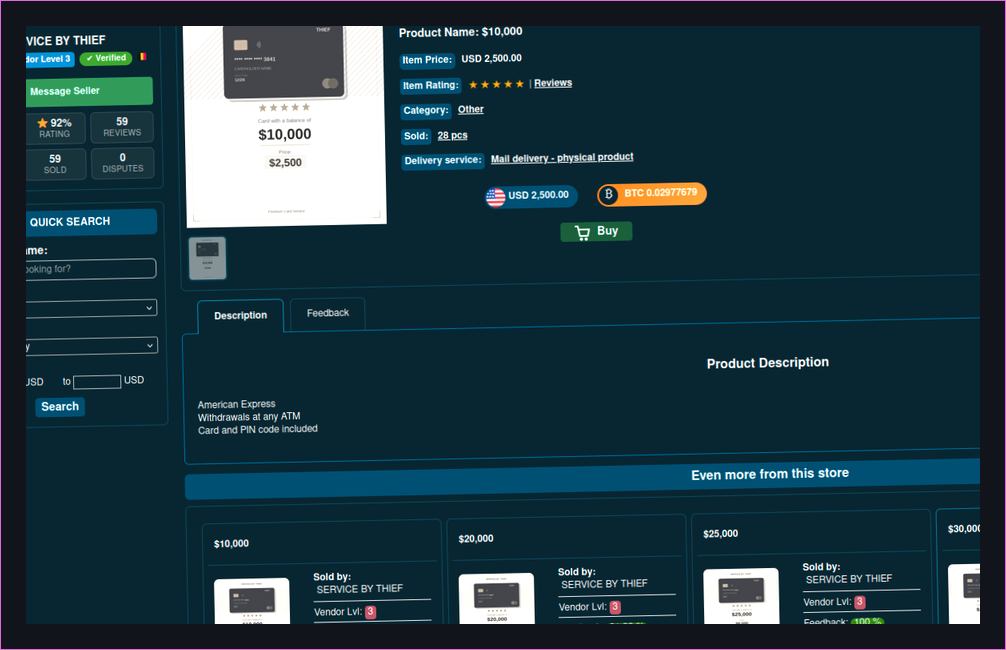
5. Why crypto didn't save him
Mark paid for the cards in Monero — a cryptocurrency specifically designed for anonymity.
Yet the chain still reached him. Here is where the investigation found the weak link:
The purchase point of Monero. To buy Monero, Mark used a centralised exchange where he completed KYC verification — uploading his passport and a selfie. The exchange, under a court order, provided his identity and transaction history. Although the subsequent movement of Monero is difficult to trace, the very fact of purchase on the right date and in the right amount became evidence.
The time window. Purchase of Monero, purchase on the marketplace, receipt of cards, ATM withdrawals — all happened within two weeks. The coincidence of time windows became circumstantial but weighty evidence.
Physical evidence. The cards found during the search contained magnetic tracks matching the dumps stolen from real victims. This is direct physical evidence that no crypto can wash away.
Video. A face on camera is evidence that cannot be laundered. Even if everything else had been perfect, the video alone would have tied Mark to the crime scene.
Think of it like leaving a receipt next to a crowbar at a break-in: the crowbar alone proves little, but the receipt, the crowbar, and the time stamp together form a chain. Mark's crypto trail worked the same way.
Mark bought the cards on a marketplace that this article does not name — the website where the purchase was made — and paid in Monero chosen specifically for its tracking difficulty.
6. What went wrong: Mark's mistakes
Six avoidable errors turned a working scheme into a federal case.
Withdrawals in one geographic radius. All four ATMs were within 40 miles of his home. Anti-fraud systems immediately flag such patterns.
No disguise. No mask, no glasses, no hat. A face on camera is a direct path to identification through DPS databases.
Using a centralised exchange to buy Monero. KYC linked his identity to the crypto purchase he later used to pay on the marketplace.
Storing evidence at home. Cards, MSR device, laptop with history — all found during the search. Digital evidence often survives deletion: Tor Browser leaves traces, and OS update history can indicate usage.
Cash at home. $3,200 seized during the search matched the denominations dispensed by the ATM. A minor detail, but it strengthened the charge.
Speed. All withdrawals in two weeks. Had he spread them over months, the anti-fraud system might not have triggered as quickly — but the cameras would have found him anyway.
Anyone researching card skimming protection on forums including carding forums dark web or cloned cards reddit will find the same theme repeated: physical evidence ends the run. The marketplace listing shown in the photo above promised delivery and support; it did not promise immunity from ATM cameras.
7. Lessons for security professionals
Mark's case is not a story of a genius criminal — it is a story about how the security system works, and works better than most cloned card buyers think.
For cybersecurity professionals, there are several takeaways:
Anti-fraud systems on the bank's side are the first and often underestimated line of defence. Pattern analysis, geolocation rules, scoring models — all of this worked automatically, before a human was involved. Banks should continue investing in ML models for anomaly detection.
Physical and digital forensics work together. The key piece of evidence — ATM video — is a physical medium. But without the digital transaction log, the video would be useless: you need to know exactly when to pull a frame. Integrating these two worlds is the foundation of a successful investigation.
Anonymous cryptocurrencies do not guarantee anonymity. The entry point into crypto (a KYC exchange) and the exit point (cash) are two ends of the chain that link the digital and physical. As long as KYC exists, full anonymity is impossible.
Customer education remains the weak link. Victims did not notice the fraud immediately. The faster a victim reports a theft, the faster the bank blocks the card — and the less the fraudster manages to withdraw. Educational work by banks with clients directly reduces damage.
8. The verdict
In March 2025, Mark T. pleaded guilty to charges of fraud and related activity in connection with access devices (18 U.S.C. § 1029) and money laundering (18 U.S.C. § 1957).
The U.S. District Court for the Middle District of Florida sentenced him to 60 months in federal prison followed by three years of supervised release, a fine of $22,000, and restitution to the three victims.
In sentencing, the judge noted that Mark was not the organiser of the scheme — he was the buyer, the final link. But it is the final link that bears the physical risk and receives the physical punishment. The organisers higher up the chain more often remain in the shadows — and that is a separate problem that law enforcement solves more slowly.
What the case proves
The case of Mark T. demonstrates that the darknet does not extend to the ATM. A cloned card is worthless the moment a camera records the face using it. The investigation combined transaction logs, geolocation, KYC records, and physical evidence into a chain that no cryptocurrency could break.
For readers researching card skimming protection, credit card skimmer protection, or how to check for credit card skimmers, the practical lesson is simple: ATMs are surveillance points first and cash dispensers second. Card skimming protector devices and credit card skimming device detector tools address the customer side, but the criminal side faces a different problem — the bank already has the evidence it needs.
The marketplace listing in the photo above promised cloned cards with delivery and support. What it could not promise was that the buyer would remain invisible. Mark T. is now in federal prison, and the organisers above him remain a separate, slower problem for law enforcement.
Questions readers ask
- How do ATM cameras identify cloned card users?
Built-in cameras record faces in 1080p with infrared for night mode. Investigators compare those images against driver's licence databases to identify the person within days.
- Why didn't Monero protect the buyer?
The buyer purchased Monero through a centralised exchange with KYC verification. A court order forced the exchange to reveal his identity and transaction history, linking him to the marketplace purchase.
- What physical evidence was found during the search?
Six blank plastic cards, a magnetic stripe read/write device, a laptop with Tor Browser traces and darknet marketplace history, $3,200 in cash, and packaging from the shipment.
- What was the sentence in this case?
Mark T. received 60 months in federal prison, three years of supervised release, a $22,000 fine, and restitution to three victims.
Further services. We keep a short list of services we check regularly. Resources