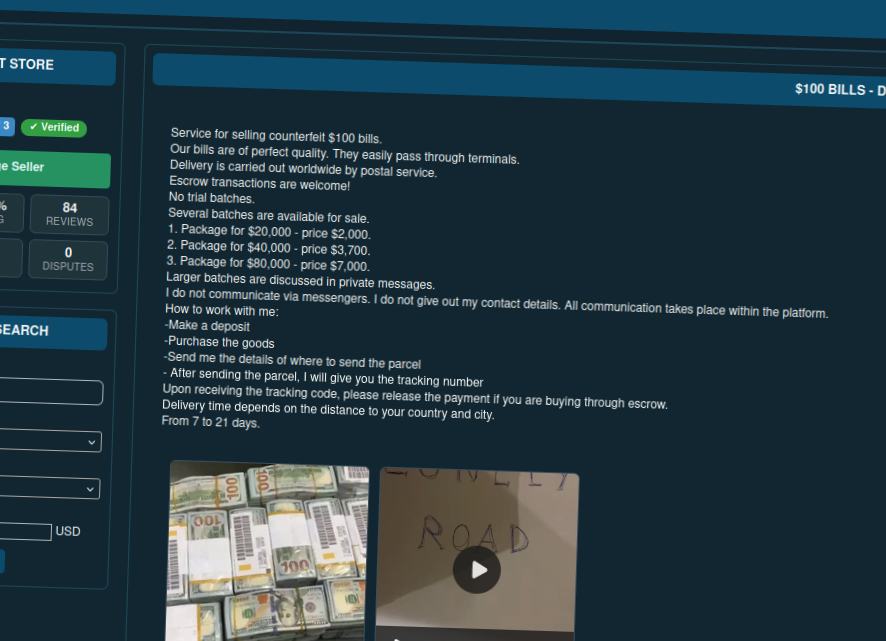
Derek H., 29, believed he had located a method that could not fail. In January 2025 he ordered 40 counterfeit $100 bills from a darknet marketplace, paying $1,200 in cryptocurrency. The listing described the notes as 2009 series forgeries with working UV protection, a magnetic strip and a watermark, a quality sometimes marketed as "superdollar" standard.
The plan was simple. Derek intended to feed the fake money dollar bills into ATMs that accept cash deposits. The machine would read each note, credit the amount to his account, and he would then withdraw or transfer the balance as genuine digital funds.
What matters
Machine acceptance is not proof that a note is genuine.
Banks review serial numbers, deposit patterns and sensor data.
The Secret Service investigates US currency counterfeiting cases.
Frozen accounts can become the main evidence against a depositor.
Advertised quality such as "superdollar" does not guarantee detection avoidance.
1. The deposit run
Two ATMs accepted the notes without hesitation and added $800 to his account. A third machine rejected one bill with a reading error. A fourth accepted a deposit but marked the transaction as "pending review."
2. How the bank responded
By the next morning the bank had frozen the account. The frozen balance included the credited deposits, and no withdrawal was possible. Three weeks later, agents from the U.S. Secret Service arrested Derek H.
The bank's review process compared serial numbers and note properties against reference data. Duplicate serials, sensor readings and deposit patterns helped flag the transactions. This is a standard procedure when a cash-accepting machine reports an anomaly on a 100 dollar fake money note.
Before assuming any note will pass through a machine, check whether the serial is duplicated, the paper texture is correct, and the UV response matches the series. These checks are similar to testing a used phone before purchase: a single failed sensor check can reveal a larger problem.
3. Market context and pricing
This case is part of a wider pattern. Listings for fake money darknet products often use phrases such as buy fake dollars or realistic fake money australia, although the notes in this incident were US currency. Some sellers offer counterfeit $20 dollar bills because smaller denominations attract less attention at retail counters. Others advertise a fake 100 dollar note with claimed security features.
Prices in these listings are often tied to quantity and the seller’s stated quality; the table below summarizes typical darknet-style offers rather than verified sales.
| Offering | Listed price | Advertised trait |
|---|---|---|
| Fake $100 note, 2009 series, single | USD 30–45 | UV, watermark, magnetic strip |
| Fake mixed-denomination bills, assorted lot | USD 150–250 | assorted denominations |
| Fake $100 notes, pack of 10 | USD 250–350 | "superdollar quality" |
| Counterfeit $20 bills, lot of 50 | USD 400–600 | basic offset print |
Some platforms describe these products as prop money dollars, while others use terms like fake counterfeit money. The phrase "prop money" is sometimes an evasion tactic in listings. Buyers searching for prop money for sale nearby may find local resellers, but the Denver case began online.
The website where the purchase was made was not named in public records. Searches for fake money site or fake dollar price often lead to forums, vendor shops, or seized domains. No .onion address is provided here because none was confirmed in the source material.
4. Enforcement outcome
The Secret Service handles US currency offences, including cases that start with buy counterfeit 20 dollar bills or larger denominations. In this instance, the arrest followed coordination between the bank and federal agents. The frozen account provided transaction records, deposit timestamps and machine identifiers.
A useful everyday analogy is a doorbell camera: the deposit attempt created a timestamped record at each machine, and those records became evidence.
What the Denver case shows
Derek H. assumed that machine acceptance meant the scheme had succeeded. Acceptance was only the first layer. The bank's review process, serial checks and flagged transactions converted the deposits into evidence.
The result was an account freeze followed by arrest. The plan to convert paper into digital balance failed at the point where the bank's records met law enforcement review.
Common questions
- What exactly did Derek H. buy?
He bought 40 counterfeit $100 bills from a darknet marketplace for $1,200 in cryptocurrency. The notes were described as 2009 series with UV protection, a magnetic strip and a watermark.
- Why did the ATMs accept some fake notes?
Cash-accepting ATMs rely on sensors and note readers, but some counterfeits can pass initial checks. Acceptance does not mean the bank will not review the deposit later.
- What triggered the freeze and arrest?
One ATM returned a bill with an error, another flagged a transaction for review, and the next morning the bank froze the account. The Secret Service arrested him three weeks later.
- Is it safe to search for fake money sites?
No. Listings using terms like buy fake dollars or fake money darknet are linked to criminal activity, and law enforcement monitors these spaces.
Further services. We keep a short list of services we check regularly. Resources